
Introduction
Urbanization is a phenomenon that has transformed the landscape of human habitation. As populations grow and cities expand, understanding how land is utilized within urban areas becomes essential for effective city planning and development. Various models have been proposed to explain the patterns of urban land use, each offering valuable insights into the dynamics of urban environments. In this article, we will explore prominent models of urban land use, including those proposed by Burgess, Harris and Ullman, and Hoyt, analyzing their key concepts and implications for urban planning.

1. Burgess Model
Ernest Burgess, an urban sociologist, introduced one of the earliest models of urban land use in 1925. Known as the concentric zone model, Burgess’s theory suggests that cities grow outward from a central core in a series of concentric rings, with each ring representing a different type of land use. The model delineates five zones:

- Central Business District (CBD): At the center of the city lies the CBD, characterized by high-density commercial activities, such as offices, retail stores, and financial institutions. Land values are typically highest in this zone due to its prime location.
- Zone of Transition: Surrounding the CBD is the zone of transition, which experiences a mix of land uses, including light manufacturing, low-income housing, and some commercial establishments. This area is in a state of flux, undergoing gradual transformation and often facing socioeconomic challenges.
- Zone of Working-Class Homes: Further outward is the zone dominated by working-class residential neighborhoods. These areas house blue-collar workers and typically feature modest single-family homes or apartments.
- Zone of Better Residences: Beyond the working-class zone lies the zone of better residences, where middle-class families reside. This area boasts more spacious homes, better amenities, and cleaner environments compared to the inner zones.
- Commuter Zone: The outermost ring consists of the commuter zone, where affluent residents live in suburban communities. This zone is characterized by low-density housing, ample green spaces, and easy access to transportation routes leading to the city center.
2. Harris and Ullman’s Multiple Nuclei Model
Developed in 1945 by Chauncy Harris and Edward Ullman, the multiple nuclei model challenges the simplicity of Burgess’s concentric zone theory by proposing that cities contain multiple centers of activity, or nuclei, which emerge based on various factors such as transportation routes, land values, and socioeconomic dynamics. Unlike Burgess’s model, which assumes a radial expansion pattern, Harris and Ullman argue that urban growth occurs more organically, with different nuclei forming and evolving independently over time. Some key nuclei identified in this model include:

- CBD: Similar to Burgess’s model, the central business district remains a focal point of commercial activity.
- Industrial Center: Areas dedicated to manufacturing and industrial activities, often located near transportation hubs such as ports or rail yards.
- Residential Suburbs: Suburban neighborhoods catering to middle and upper-class residents seeking a quieter lifestyle away from the urban core.
- Ethnic Neighborhoods: Enclaves formed by immigrant communities, characterized by cultural institutions, ethnic businesses, and social networks.
- Educational and Health Centers: Zones housing universities, hospitals, and research institutions, which serve as hubs for knowledge dissemination and healthcare services.
Harris and Ullman’s model acknowledges the complex interactions between different land uses and emphasizes the decentralized nature of urban development.
3. Hoyt’s Sector Model
Developed by Homer Hoyt in 1939, the sector model builds upon Burgess’s concentric zone theory by introducing the concept of sectors of growth radiating outward from the city center. Unlike Burgess’s model, which assumes uniform expansion in all directions, Hoyt’s model suggests that certain sectors experience more rapid growth and development due to environmental or economic advantages. The key features of the sector model include:
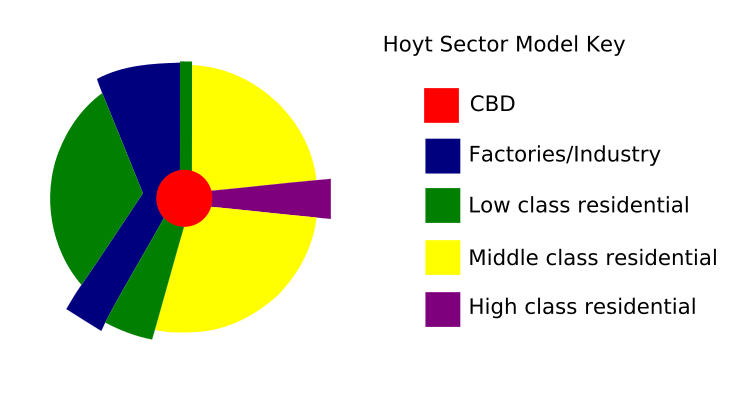
- CBD: Similar to other models, the central business district serves as the economic heart of the city, attracting commercial and financial activities.
- Transportation Corridors: Major transportation routes such as highways, railways, or rivers form natural axes of development, leading to the emergence of linear corridors characterized by industrial or commercial activities.
- High-Class Residential Zones: Affluent neighborhoods often develop along the periphery of the city, offering panoramic views or access to recreational amenities such as parks or waterfronts.
- Low-Class Residential Zones: Working-class neighborhoods may concentrate in specific sectors, often adjacent to industrial areas or along transportation routes.
- Suburban Ring: As urbanization progresses, suburban developments expand outward from the city center along transportation corridors, creating a ring of low-density housing and commercial establishments.
Hoyt’s sector model emphasizes the role of transportation and topography in shaping urban growth patterns, highlighting the importance of accessibility and spatial organization.
Analyzing Urban Land Use Patterns
While each of these models offers valuable insights into the complexities of urban land use, it’s essential to recognize that real-world cities often exhibit a combination of characteristics from multiple models. Factors such as historical development patterns, economic forces, and government policies can influence the spatial distribution of land uses in unique ways. Urban planners and policymakers must consider these factors when designing strategies for sustainable development and equitable growth.
Key Points to Consider:
- Dynamic Nature: Urban land use patterns are constantly evolving in response to changing demographic, economic, and environmental factors.
- Social Equity: Access to essential services, housing, and employment opportunities varies across different zones within a city, highlighting the need for inclusive urban planning.
- Environmental Sustainability: Urban development practices can impact natural ecosystems, air quality, and resource consumption, necessitating measures to promote eco-friendly design and infrastructure.
- Transportation Planning: Efficient transportation networks play a crucial role in shaping urban form and connectivity, influencing land use decisions and travel behavior.
- Mixed-Use Development: Integrating diverse land uses within neighborhoods can enhance walkability, reduce dependence on cars, and foster vibrant urban communities.
Conclusion
Models of urban land use provide conceptual frameworks for understanding the spatial organization of cities and the factors driving their development. While each model offers valuable insights, no single model can fully capture the complexity of urban dynamics. By integrating elements from multiple models and considering local context and stakeholders’ needs, urban planners can create more resilient, inclusive, and sustainable cities for future generations.
Frequently Asked Questions (FAQs):
- How do urban land use models help in city planning?
- Urban land use models offer simplified representations of real-world urban systems, helping planners identify trends, forecast growth, and allocate resources effectively.
- Are these models universally applicable to all cities worldwide?
- No, urban land use models are based on observations of specific cities and may not accurately represent the diversity of urban forms found globally. Local context and cultural factors play a significant role in shaping land use patterns.
- What are some criticisms of these models?
- Critics argue that urban land use models oversimplify the complexities of urban systems and fail to account for factors such as social dynamics, political influences, and spatial heterogeneity.
- How can urban planners address issues of gentrification and displacement?
- Strategies such as inclusionary zoning, affordable housing initiatives, and community land trusts can help mitigate the negative impacts of gentrification and ensure equitable development.
- What role does technology play in modern urban planning practices?
- Technologies such as Geographic Information Systems (GIS), remote sensing, and data analytics enable planners to collect, analyze, and visualize spatial data, facilitating evidence-based decision-making and participatory planning processes.
References:
- Burgess, E. W. (1925). The growth of the city: An introduction to a research project.
- Harris, C. D., & Ullman, E. L. (1945). The nature of cities.
- Hoyt, H. (1939). The structure and growth of residential neighborhoods in American cities.


